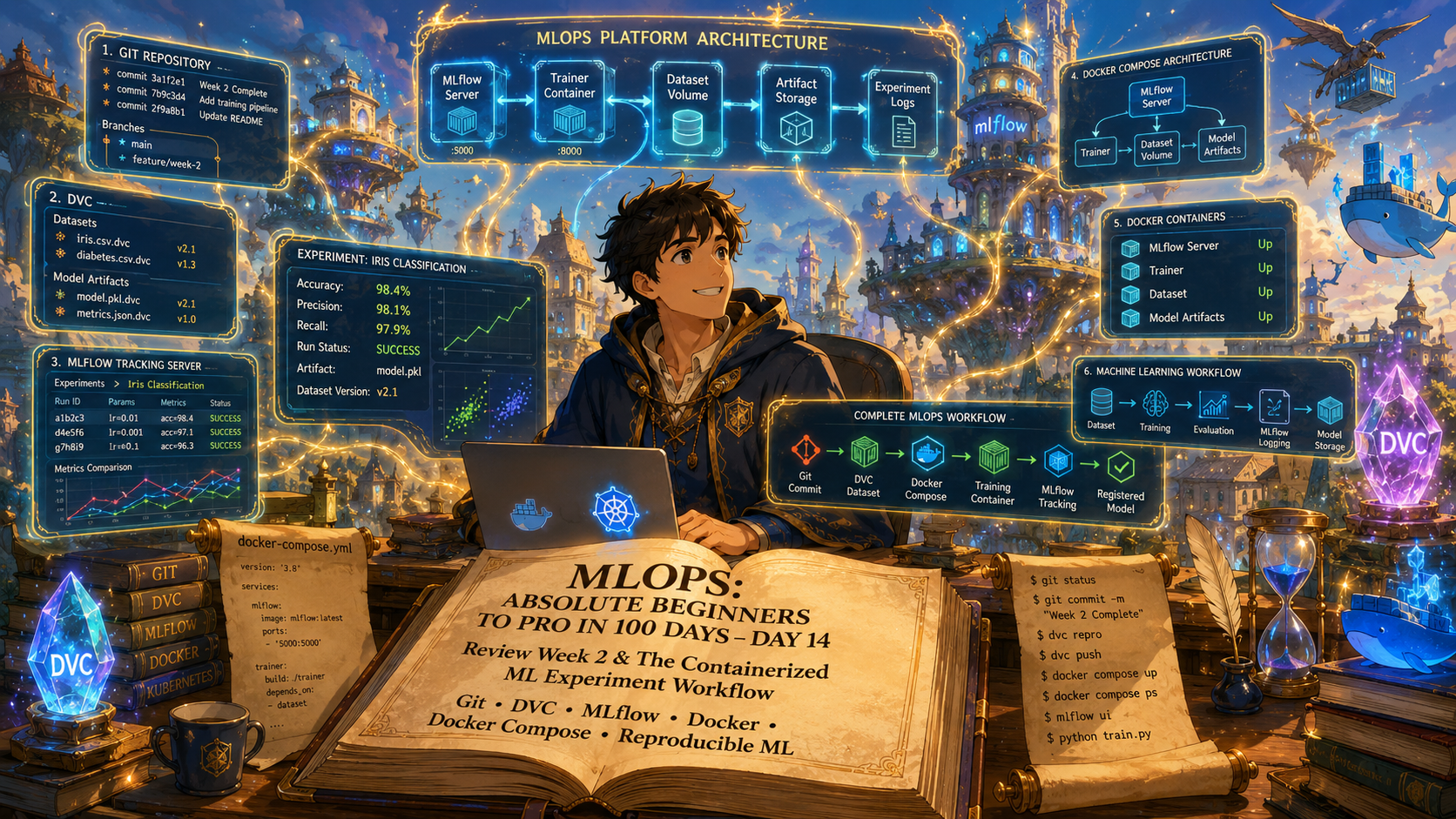
Review Week 2 & The Containerized ML Experiment Workflow
Two weeks in, you have all the pieces: Git and DVC for versioning, MLflow for tracking, and Docker for reproducible environments. A single docker compose up that spins up a tracking server, runs a versioned experiment, and logs every result.
By Sandip Das · · 10 min read
💡
Hey — It's Sandip Das 👋
This workflow is the foundation of reproducible and production-ready machine learning, ensuring every experiment, dataset, model, and environment is fully versioned and traceable.
Mastering it eliminates "works on my machine" problems, accelerates collaboration, and creates a seamless path from experimentation to deployment.
📚 Key Learnings
- Why integrate the three tools
- Week 2 concept recap (Days 8–13)
- Who owns what: tool responsibilities
- The unified workflow diagram
- Tracing one experiment end-to-end
- Building it: full project walkthrough
- Running and verifying the workflow
- Common pitfalls & fixes
🧠 Learn here
Three tools, one promise: reproducibility
Over the past week you learned each tool in isolation. That was deliberate — you can't orchestrate instruments you can't play. But in a real MLOp
Read the full article on learnxops.com.
Topics: 100 Days of MLOps, MLOps, ML, Community, Docker Compose, Docker