Model Serving Fundamentals & REST APIs
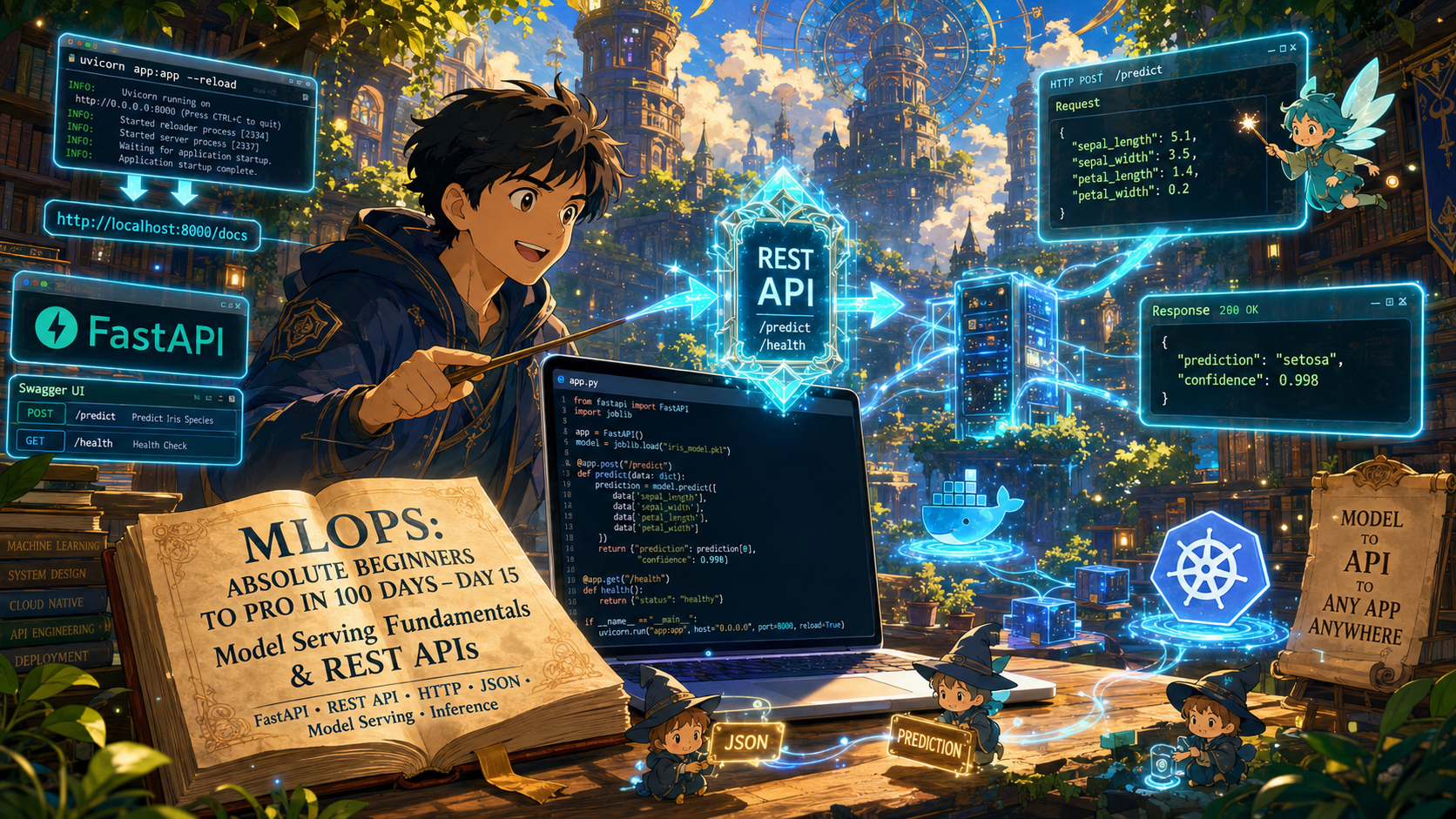
A trained model sitting in a .pkl file helps nobody. Today your iris classifier gets a front door: a REST API that any application, in any language, can call over HTTP.
By Sandip Das · · 13 min read
💡
Hey — It's Sandip Das 👋
Model serving is what transforms a trained model into a production-ready service that real applications can consume through standard HTTP APIs.
Every MLOps engineer must master REST-based model serving to build scalable, language-agnostic AI systems that can be reliably deployed, integrated, and monitored in production.
📚 Key Learnings
- Why model serving matters
- REST fundamentals for ML engineers
- Flask vs FastAPI
- Anatomy of a prediction request
- Build the iris prediction API
- Run, test & explore the docs
- Containerize the service
- Common pitfalls & debugging
LearnXops Labs:
🧠 Learn here
Why model serving matters
For fourt
Read the full article on learnxops.com.
Topics: 100 Days of MLOps, MLOps, ML, Community, Python, AI Interfacing