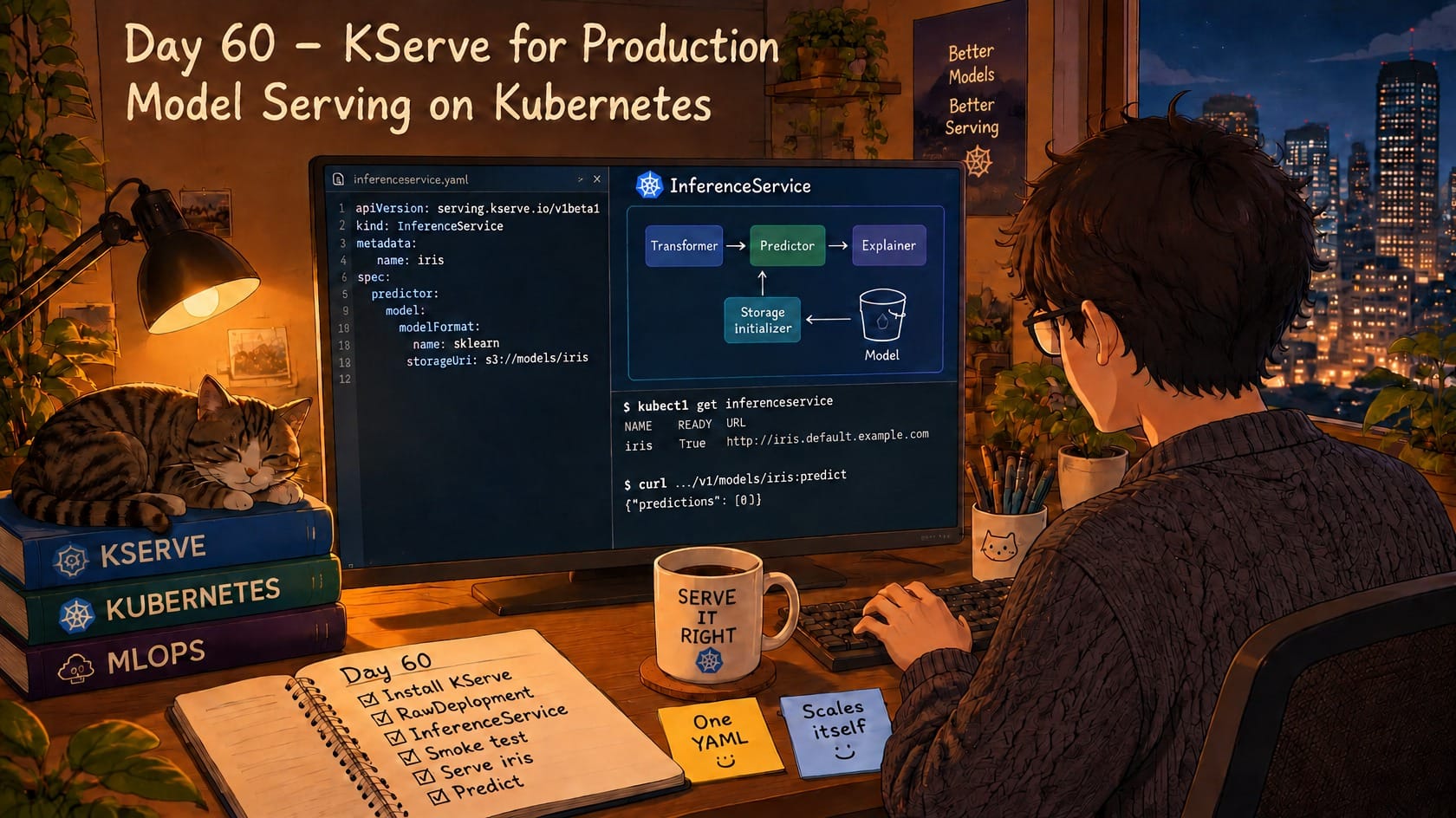
KServe for Production Model Serving on Kubernetes
Replace Hand-Written Deployments With One InferenceService That Pulls Your Model, Serves a Standard Protocol, and Scales Itself. (MLOPS: ABSOLUTE BEGINNERS TO PRO IN 100 DAYS - DAY 60)
By Sandip Das · · 5 min read
💡
Hey — It's Sandip Das 👋
In Day 59 we gave ML workloads requests, limits, quotas and their own GPU nodes. Our serving setup, however, is still a hand-written Deployment + Service per model, with probes, image builds and rollout logic repeated every time.
Today we hand that to KServe: install it on minikube, learn the InferenceService CRD and its predictor, transformer and explainer components, and serve the iris scikit-learn model with a single YAML file.
📚 Key Learnings
- What KServe adds on top of plain Deployments for model serving
- The InferenceService CRD and how a
storageUribecomes a running model server - Predictor, transformer and explainer: what each component is for
- Serverless vs RawDeployment mode, and the v1 / v2 inference protocols
- Hands-on: install KServe on minikube and serve iris with on
Read the full article on learnxops.com.
Topics: 100 Days of MLOps, MLOps, ML, KServe