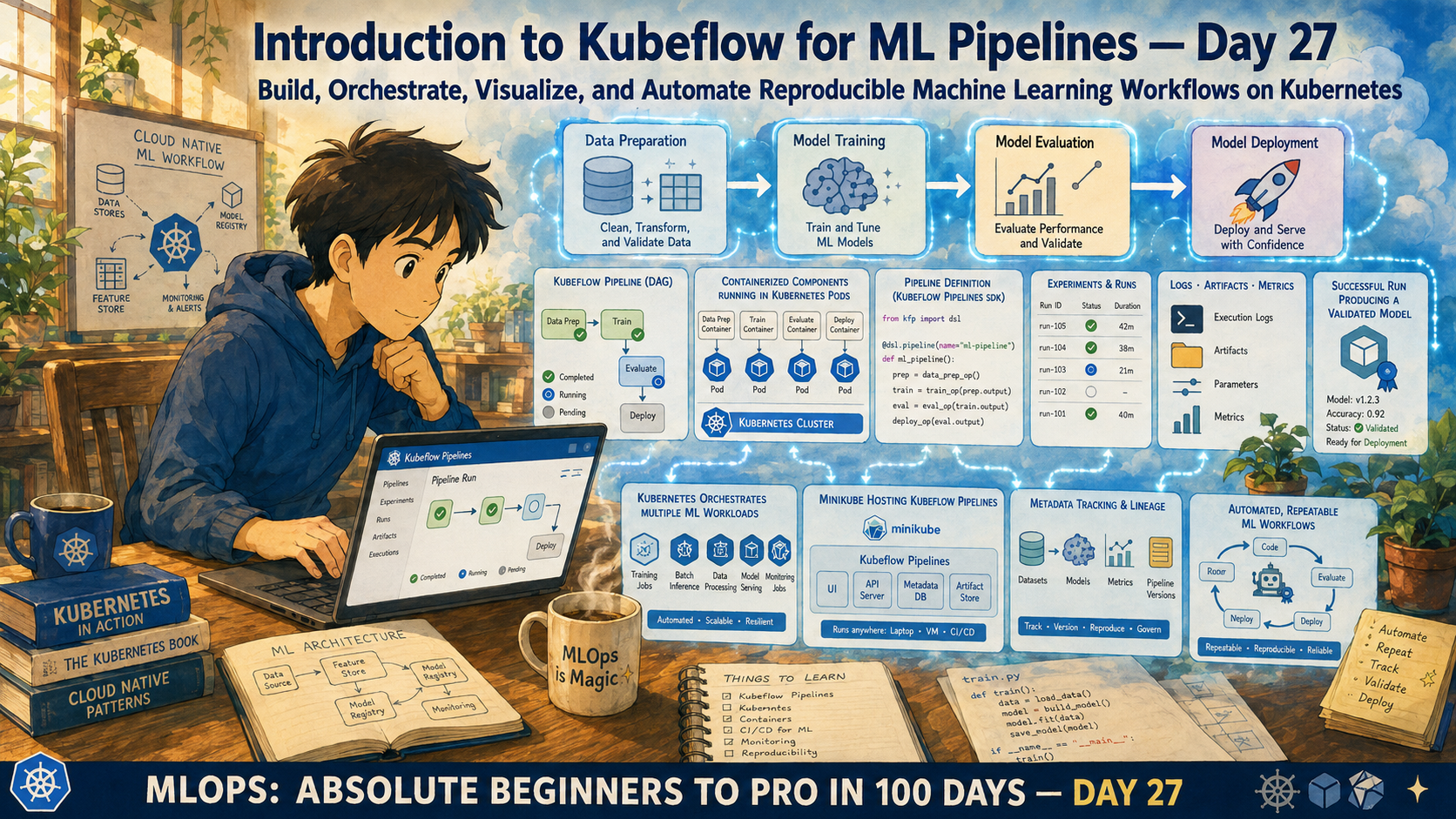
Introduction to Kubeflow for ML Pipelines
Build, Orchestrate, Visualize, and Automate Reproducible Machine Learning Workflows on Kubernetes
By Sandip Das · · 26 min read
💡
Hey — It's Sandip Das 👋
Learn Kubeflow to build, orchestrate, track, and reproduce end-to-end ML workflows directly on Kubernetes.
It also provides a scalable foundation for automating experiments, model training, optimization, and production deployment using Pipelines, Katib, and KServe.
Learn Kubeflow to build, orchestrate, track, and reproduce end-to-end ML workflows directly on Kubernetes.
It also provides a scalable foundation for automating experiments, model training, optimization, and production deployment using Pipelines, Katib, and KServe.
📚 Key Learnings
- Why an orchestrator, and why now
- What Kubeflow actually is
- The component tour: Pipelines, Katib, KServe
- Kubeflow Pipelines architecture
- Core pipeline concepts
- KFP v1 vs v2 (and the doc trap)
- Install KFP on minikube
- The UI tour
- Your first pipeline
- The iris-mlops pipeline
- What happens when you hit Start
- Caching, artifacts and metadata
- Katib Quick Start
- KServe Quick Start
- Troubleshooting Guide
🧠 Learn here
Why an orchestrator, and why now
Look at what your Read the full article on learnxops.com. Topics: 100 Days of MLOps, MLOps, ML, Kubernetes, Kubeflowi