Introduction to Helm for ML Application Packaging
Package, Configure, Deploy, Upgrade, and Roll Back ML Applications on Kubernetes with Helm
By Sandip Das · · 30 min read
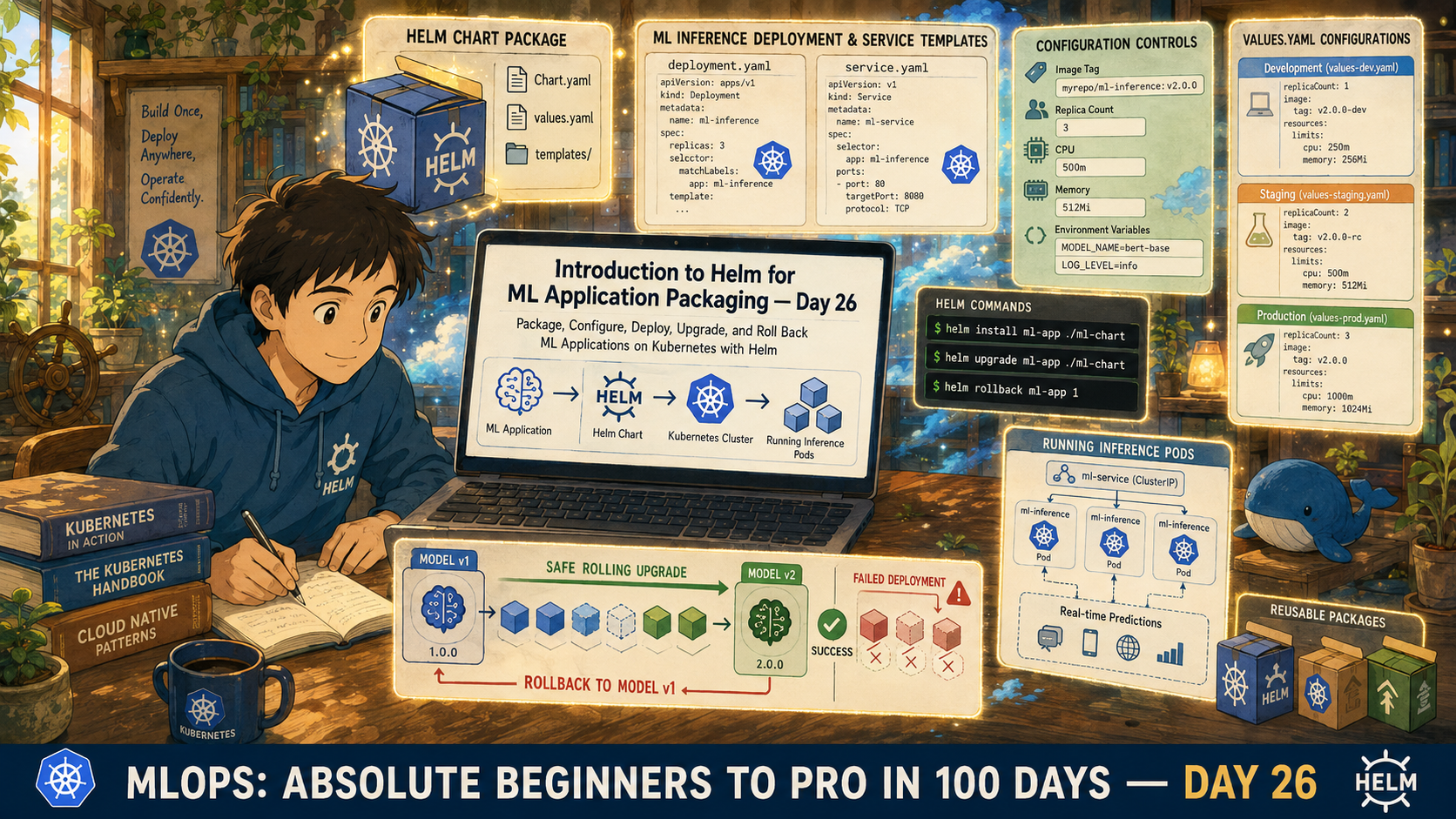
💡
Hey — It's Sandip Das 👋
Helm helps us package complex Kubernetes manifests into reusable, configurable charts for consistent ML application deployments across environments.
It also simplifies versioned releases, upgrades, and rollbacks—making model-serving deployments faster, safer, and easier to automate.
Helm helps us package complex Kubernetes manifests into reusable, configurable charts for consistent ML application deployments across environments.
It also simplifies versioned releases, upgrades, and rollbacks—making model-serving deployments faster, safer, and easier to automate.
📚 Key Learnings
- Why raw manifests stop scaling
- What Helm actually is
- Installing Helm 3
- Chart anatomy, file by file
- The templating language
- Designing values.yaml
- Install, upgrade, rollback
- Where Helm stores release state
- Hands-on: the iris-mlops chart
- Deploying on minikube
- Linting, templating, testing
- Dependencies, hooks, OCI registries
- Troubleshooting reference
- Best practices for ML charts
🧠 Learn here
Why raw manifests stop scaling
Over
Read the full article on learnxops.com.
Topics: 100 Days of MLOps, MLOps, ML, Kubernetes, Helm