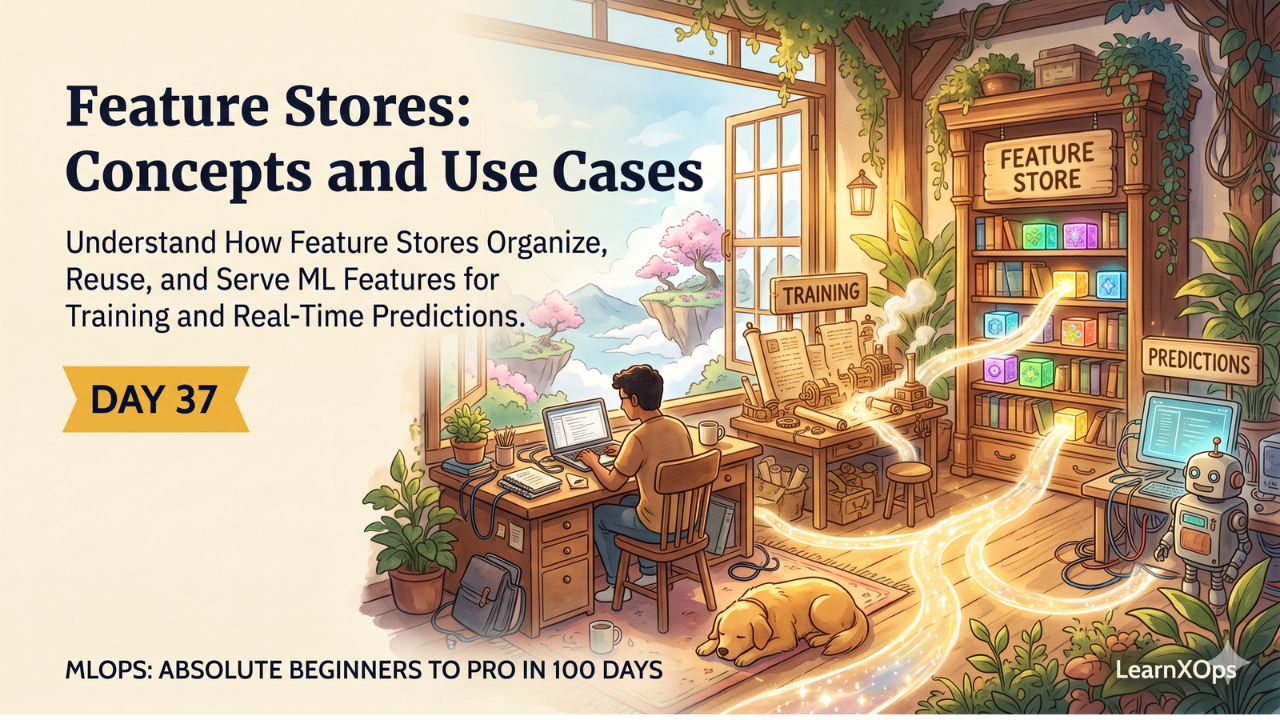
Feature Stores: Concepts and Use Cases
Understand How Feature Stores Organize, Reuse, and Serve ML Features for Training and Real-Time Predictions.
By Sandip Das · · 7 min read
💡
Hey — It's Sandip Das 👋
Feature stores help us in building reliable infrastructure that delivers consistent ML features for training and real-time predictions.
Understanding offline stores, online stores, and feature registries helps them manage data access, automate feature updates, and support ML workloads at scale.
Feature stores help us in building reliable infrastructure that delivers consistent ML features for training and real-time predictions.
Understanding offline stores, online stores, and feature registries helps them manage data access, automate feature updates, and support ML workloads at scale.
📚 Key Learnings
- The problem a feature store solves
- Three building blocks
- Point-in-time correctness
- Feast vs Tecton vs Hopsworks
- Hands-on: Feast for iris-mlops
🧠 Learn here
The problem a feature store solves
Picture a fraud model. In training, a data scientist computes avg_txn_amount_7d in a notebook with pandas over the warehouse. In production, a backend engineer rewrites that same logic in Java against a live database. Six weeks later accuracy drops and nobody knows why. The two implementations disagree on a time
Read the full article on learnxops.com.
Topics: 100 Days of MLOps, MLOps, ML, GitOps, ArgoCD