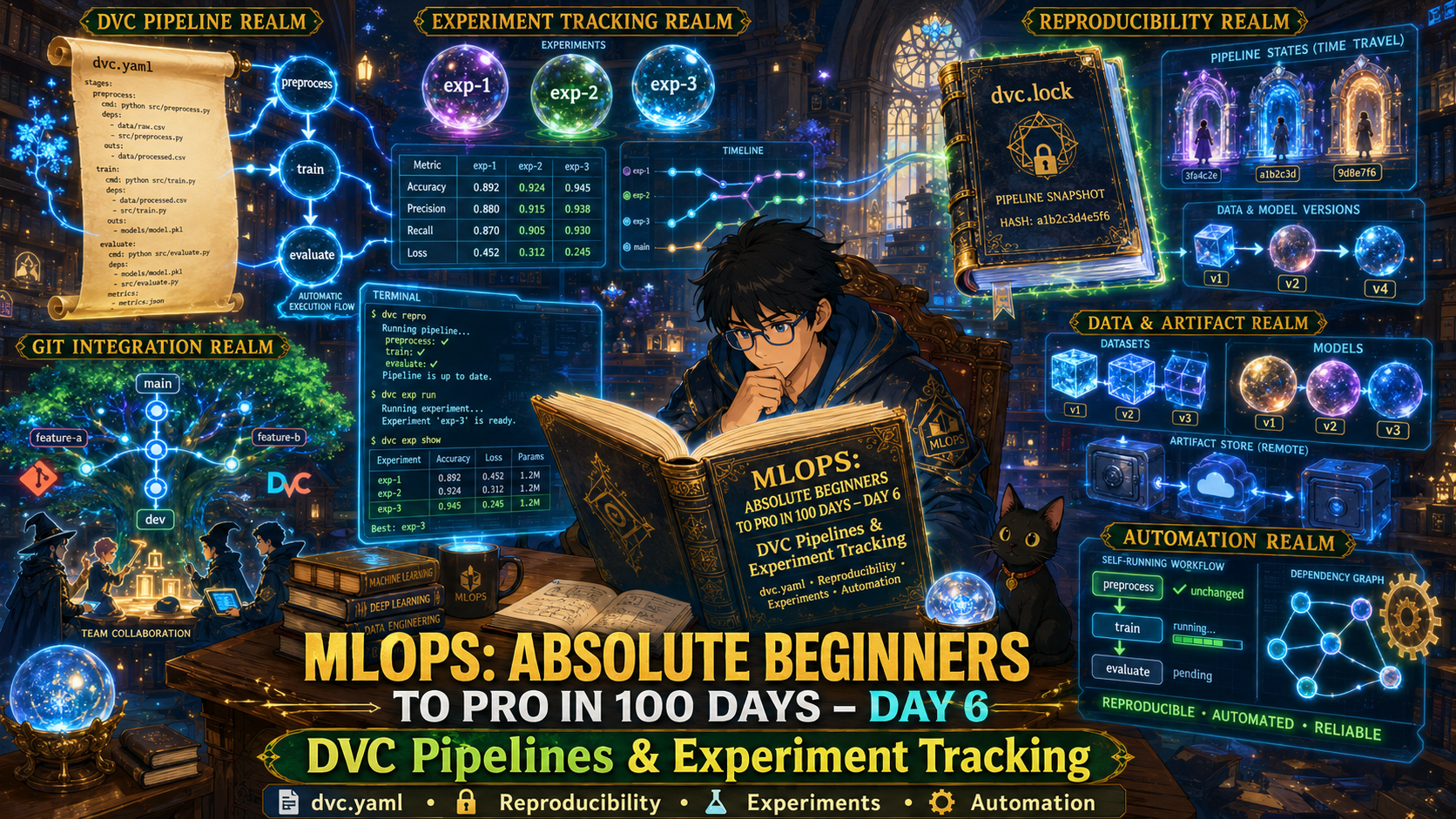
DVC Pipelines & Experiment Tracking
Stop running scripts manually. Learn how to define reproducible, dependency-aware ML pipelines using DVC's declarative dvc.yaml, track every run automatically, and share exact pipeline states with your team — no Makefile required.
By Sandip Das · · 12 min read
💡
Hey — It's Sandip Das 👋
As MLOps engineer we will have to increasingly operate ML workflows in production, and understanding DVC pipelines helps us build reproducible, dependency-aware automation with the same discipline used in CI/CD systems.
Learning experiment tracking and pipeline versioning enables reliable collaboration, easier rollbacks, and consistent deployments across teams and environments.
📚 Key Learnings
- Understand the DVC pipeline execution model
- Write dvc.yaml stages with deps, outs, params
- Use dvc repro for smart stage re-execution
- Inspect pipeline graphs with dvc dag
- Track experiments with dvc exp run
- Build a two-stage preprocess → train pipeline
LearnXops Labs:
🧠 Learn here
Read the full article on learnxops.com.
Topics: 100 Days of MLOps, MLOps, ML, Community, Python, DVC, DVC Pipelines, Experiment Tracking