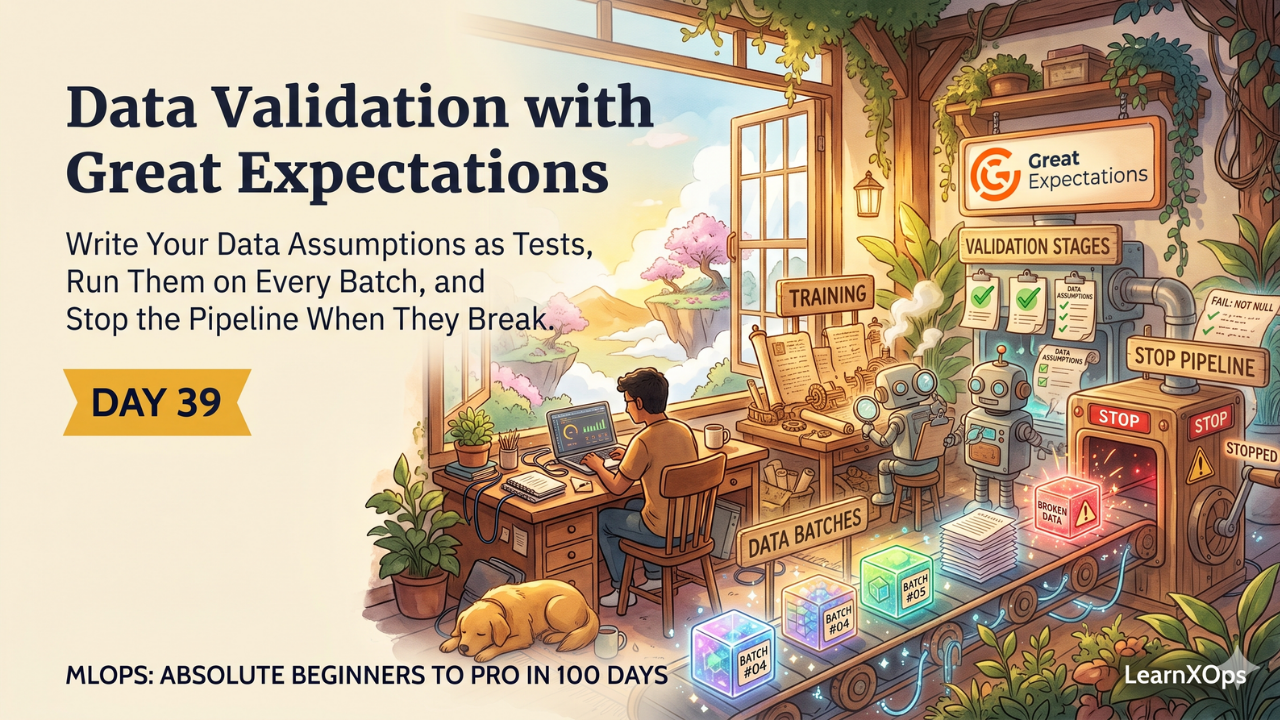
Data Validation with Great Expectations
Write Your Data Assumptions as Tests, Run Them on Every Batch, and Stop the Pipeline When They Break.
By Sandip Das · · 6 min read
💡
Hey — It's Sandip Das 👋
In Day 38 we served features from the Feast online store in milliseconds. But a feature store happily serves whatever data you feed it, good or bad.
Today we put a gate in front of the pipeline: write your assumptions about the iris data as tests with Great Expectations, run them on every batch, and stop training the moment they break.
📚 Key Learnings
- Why data bugs are more dangerous than code bugs
- The GX vocabulary: Data Context, Expectations, Suites, Validation Definitions, Checkpoints
- Running a checkpoint and reading the Data Docs HTML report
- Failing DVC and CI pipelines automatically when data quality checks fail
- Hands-on: a full validation suite for iris-mlops, verified end to end
🧠 Learn here
Why validate data at all?
Code bugs crash lou
Read the full article on learnxops.com.
Topics: 100 Days of MLOps, MLOps, ML, GitOps