Capstone: Model Training and Experiment Tracking
Train Three Model Families, Log Every Run to MLflow, Search Hyperparameters, and Promote the Winner to Staging in the Model Registry. (MLOPS: ABSOLUTE BEGINNERS TO PRO IN 100 DAYS - DAY 73)
By Sandip Das · · 4 min read
💡
Hey — It's Sandip Das 👋
In Day 72 we built a DVC pipeline that validates raw churn data and produces versioned train and test sets. Now we need a model, and "I tried a few things in a notebook" is not an answer you can defend.
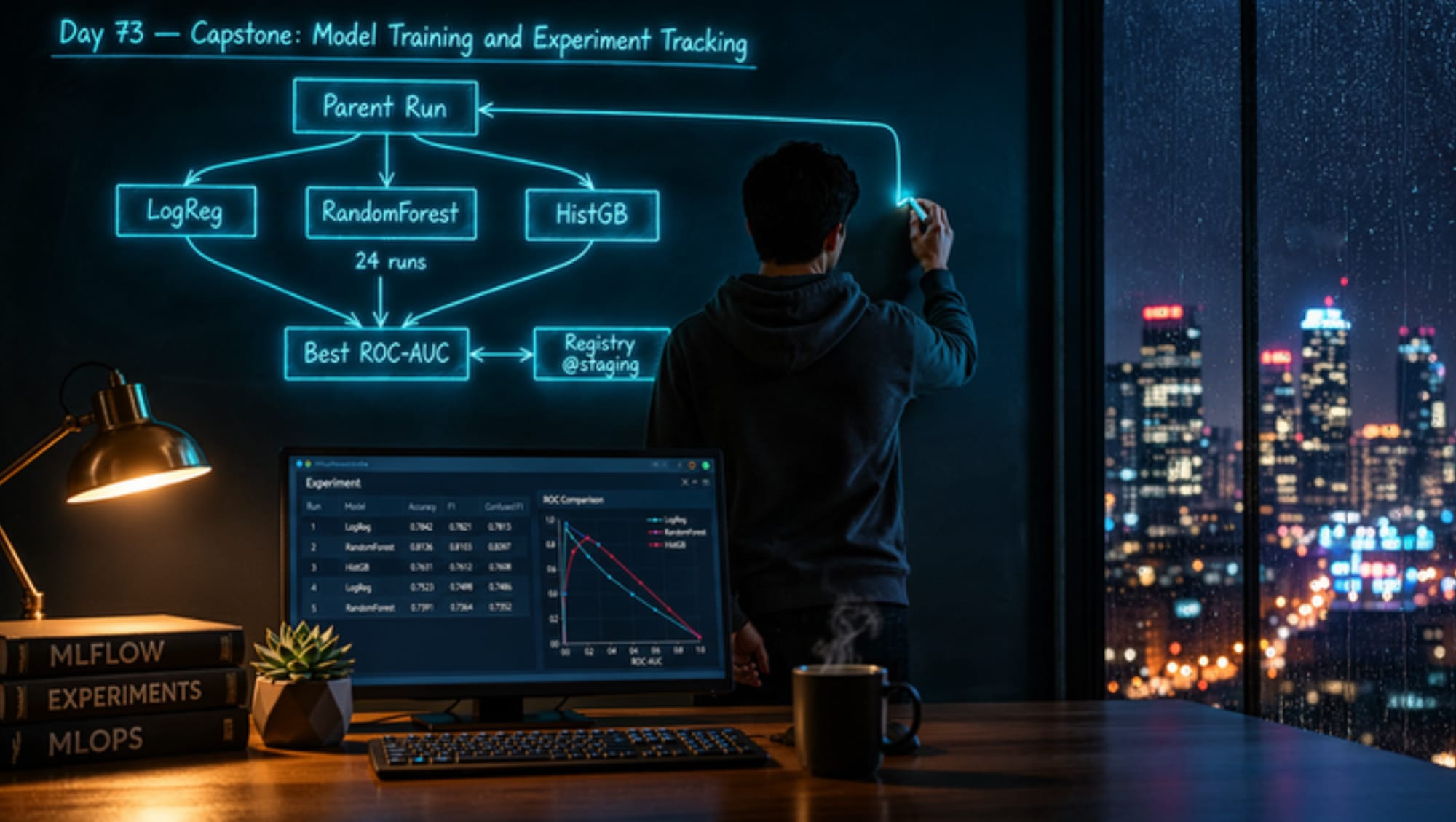
Today we train three model families, run 20+ tracked experiments with a hyperparameter search, compare them in the MLflow UI, and register the winner as our Staging model.
📚 Key Learnings
- Why you compare model families before tuning any one of them
- Linear, bagging and boosting ensembles: what each brings to tabular data
- Structuring experiments with parent and nested child runs in MLflow
- Random hyperparameter search that logs every trial
- Hands-on: 24 runs, pick the best by ROC-AUC, register it with the
stagingalias
🧠 Learn here
Why train more than one
Read the full article on learnxops.com.
Topics: 100 Days of MLOps, MLOps, ML, MLflow