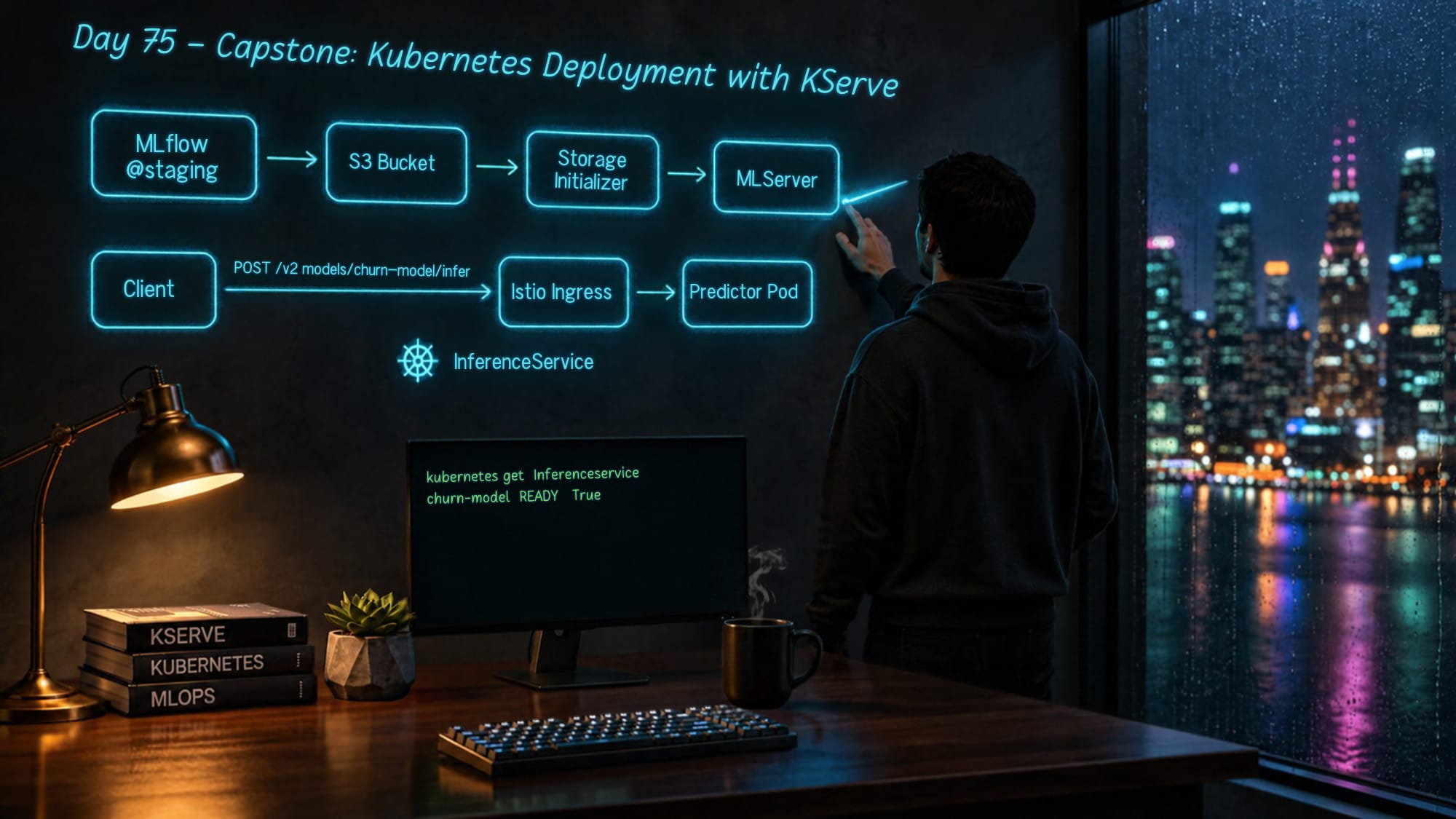
Capstone: Kubernetes Deployment with KServe
Export Your Registered MLflow Model to S3, Serve It With a KServe InferenceService, and Prove It With 100 Successful V2 Prediction Requests. (MLOPS: ABSOLUTE BEGINNERS TO PRO IN 100 DAYS - DAY 75)
By Sandip Das · · 4 min read
💡
Hey — It's Sandip Das 👋
In Day 74 we built a GitHub Actions pipeline that tests, retrains, reports metrics on every PR and pushes a serving image. A tested model that isn't serving traffic still has zero business value.
Today we deploy the capstone model to Kubernetes with KServe: export the MLflow model to S3, describe it in one InferenceService manifest, and hit it with 100 prediction requests.
📚 Key Learnings
- Custom FastAPI image vs KServe model server: when to use which
- How KServe pulls an MLflow model from S3 with a storage initializer
- Writing a v1beta1 InferenceService for the MLflow format with the V2 protocol
- Giving KServe S3 access through a ServiceAccount and secret
- Hands-on: deploy, send 100 V2 inference requests, verify all succeed
🧠 Learn here
Read the full article on learnxops.com.
Topics: 100 Days of MLOps, MLOps, ML, Kubernetes