Advanced Kubernetes: Resource Management for ML Workloads
Use Requests, Limits, Quotas, Taints and Node Affinity So Training Jobs Land on GPU Nodes and Never Starve Your Serving Pods. (MLOPS: ABSOLUTE BEGINNERS TO PRO IN 100 DAYS - DAY 59)
By Sandip Das · · 5 min read
💡
Hey — It's Sandip Das 👋
In Day 58 we packaged our cloud resources into a reusable Terraform module for dev and prod. Inside the cluster, though, everything still shares nodes on a first-come basis: one greedy training pod can starve the iris API, and an expensive GPU node can end up running a log shipper.
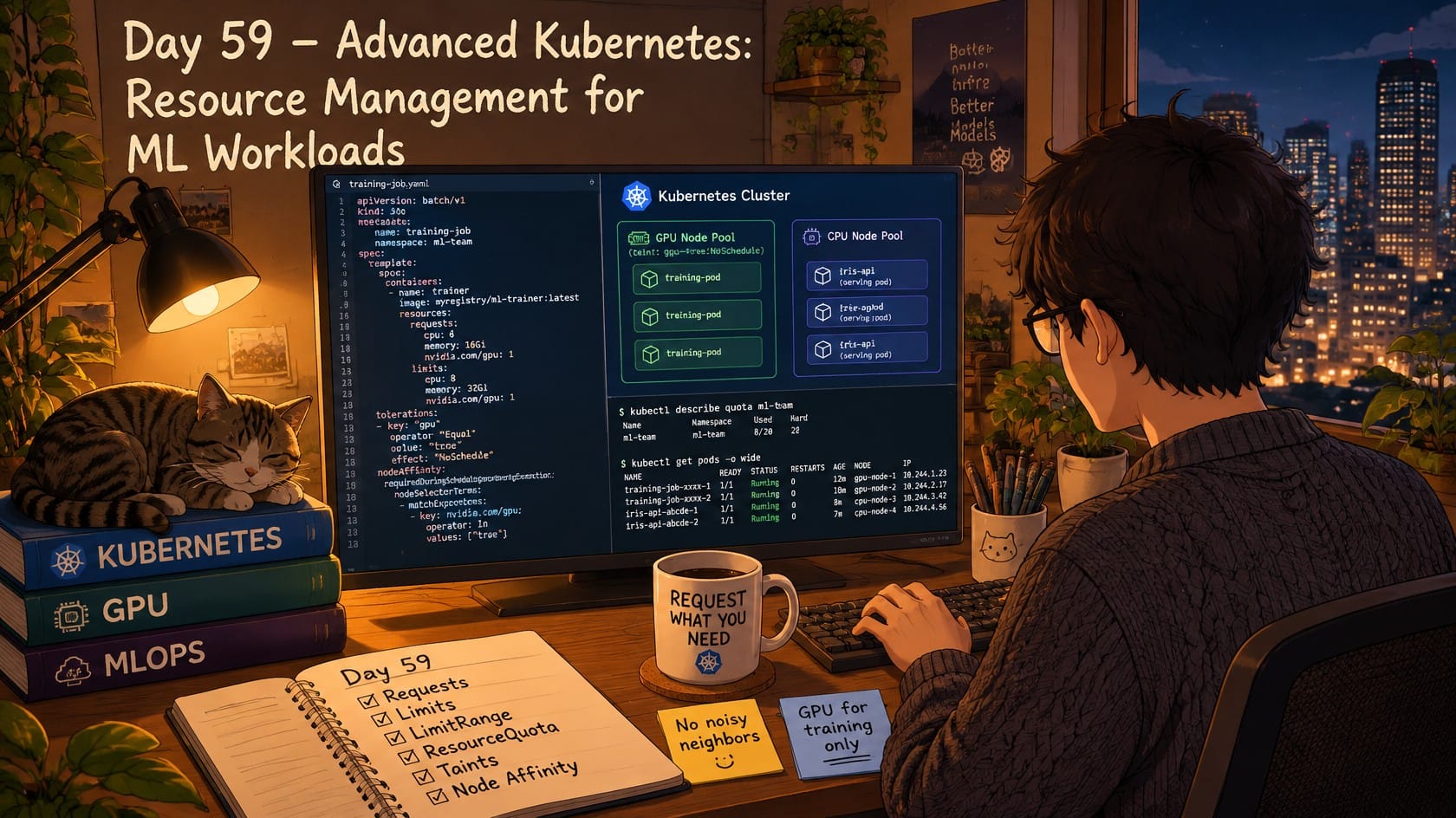
Today we take control: requests and limits, LimitRanges and ResourceQuotas per team namespace, and GPU node pools with taints, tolerations and node affinity, finished with a GPU training Job manifest.
📚 Key Learnings
- How requests and limits drive scheduling, throttling, OOM kills and QoS classes
- LimitRange for per-pod defaults and ResourceQuota for per-namespace budgets
- How GPUs appear in Kubernetes (
nvidia.com/gpu) and why they are all-or-nothing - Taints, tolerations and node affinity: keeping GPU nodes for GPU work only
- Hands-on: a GPU training Job with r
Read the full article on learnxops.com.
Topics: 100 Days of MLOps, MLOps, ML, Kubernetes